



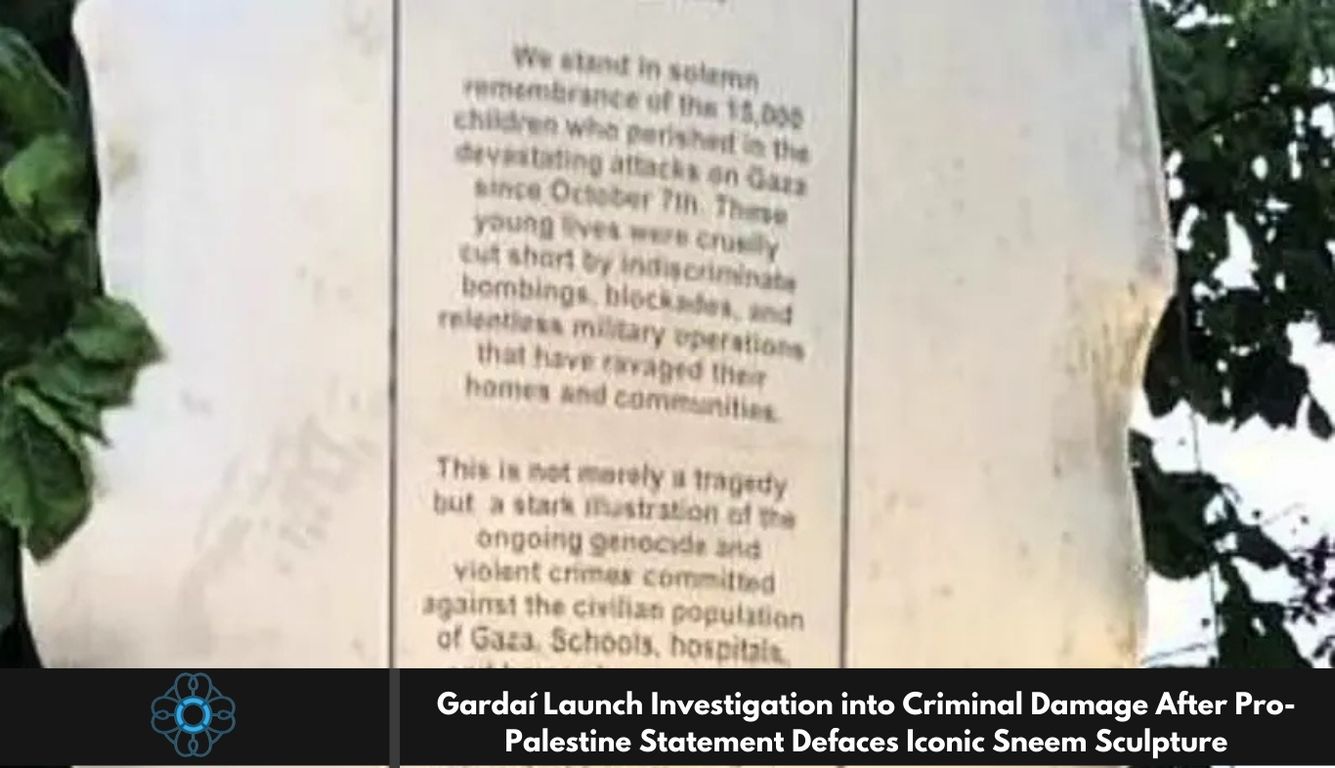

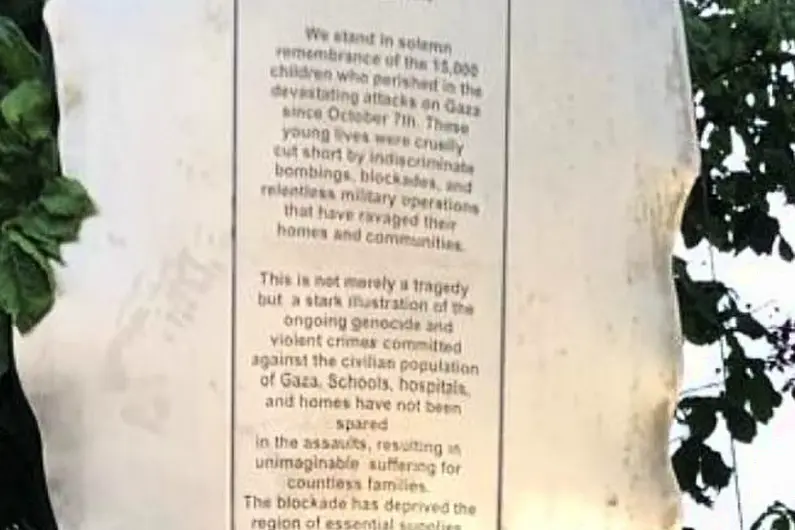
A pro-Palestine statement affixed to a sculpture in the village of Sneem has sparked a criminal damage investigation by Gardaí. The stainless-steel monument, a gift from Israel to honor former Irish President Cearbhall Ó Dálaigh, was defaced with a statement highlighting the loss of Palestinian children in Gaza. The act has prompted widespread discussion over the intersection of political protest, public property, and cultural monuments.
The monument, designed by an Israeli sculptor, was unveiled in 1985 to commemorate Ó Dálaigh’s close ties with Ireland’s Jewish community. Its placement in the picturesque village of Sneem had long symbolized the bond between Ireland and Israel. The recent incident, however, has raised questions about the role of public monuments in political expression.
Gardaí are currently investigating the act, which occurred between July 26th and July 30th, and have appealed for witnesses or anyone with information to come forward. As the investigation unfolds, the incident highlights broader conversations surrounding freedom of expression, the preservation of public art, and the impact of global conflicts on local communities.
The Sneem Sculpture: A Monument to President Cearbhall Ó Dálaigh
Historical Significance of the Sculpture
The stainless-steel sculpture in question was a gift from Israel, unveiled in 1985. It was presented to the village of Sneem in honor of Cearbhall Ó Dálaigh, a former Irish president who passed away in 1978. The monument, designed by an Israeli sculptor, commemorates Ó Dálaigh’s close ties with Dublin’s Jewish community. The sculpture’s significance lies not only in its design but also in its political and historical context.
Ó Dálaigh was an essential figure in Irish politics, and his connections to the Jewish community were a defining aspect of his legacy. This relationship was reflected in the Israeli gift of the sculpture, a symbolic gesture recognizing Ó Dálaigh’s role in fostering goodwill between Ireland and Israel.
Unveiling of the Sculpture and Its Symbolism
The monument was unveiled by Chaim Herzog, the then-President of Israel, in a ceremony that highlighted the solid diplomatic and personal ties between Ireland and Israel. This event was a significant moment in Irish and Israeli history, representing the mutual respect between the two nations. The sculpture itself, titled “In Memory of the Innocent 15,000 Children of Palestine,” serves as a poignant reminder of the ongoing conflict in the Middle East.
The Pro-Palestine Statement: A Controversial Act of Protest
What Was the Statement?
The statement that caused the controversy was a lengthy pro-Palestine message titled “In Memory of the Innocent 15,000 Children of Palestine.” The statement, which was over 300 words in length, expressed solemn remembrance for the Palestinian children who died during the recent attacks on Gaza. It did not refer to the events of October 7th, when Hamas launched an attack on Israel, but focused entirely on the victims of the Gaza conflict.
The statement’s wording emphasized the tragic loss of innocent lives, explicitly targeting the deaths of 15,000 Palestinian children in the wake of military operations. This act of protest was evidently designed to draw attention to the Palestinian cause. Still, its placement on the sculpture—an Irish-Israeli gift—raised questions about the appropriateness of such political expressions in public spaces.
The Political Implications of the Statement
The statement, while peaceful in its tone, represents the complex political dynamics surrounding the Israel-Palestine conflict. The timing of the statement’s appearance on the sculpture coincided with a period of heightened tensions in Gaza, making the issue all the more sensitive. The message itself, by omitting reference to Israeli casualties and focusing solely on Palestinian victims, reflected one side of the ongoing conflict, further complicating the narrative.
While protests and political statements are a fundamental part of democratic expression, the location of this particular protest—on a monument given by Israel—made it a deeply symbolic gesture. It called attention not only to the Israeli-Palestinian conflict but also to the role of historical monuments in public discourse.
The Investigation: Gardaí Probe Criminal Damage
What Happened After the Statement Was Found?
The Gardaí, Ireland’s national police force, launched an investigation into the criminal damage to the monument after the statement was discovered. The statement, which was affixed to the sculpture, was removed shortly after it was found. Authorities are now asking for witnesses who may have seen the incident, which is believed to have occurred between Saturday, July 26th, and Tuesday, July 30th.
While the political nature of the statement may have been controversial, the focus of the investigation is on the damage caused to the monument itself. The sculpture, a stainless-steel work of art, is considered a valuable public piece, and defacing it is seen as an act of vandalism under Irish law.
Potential Legal Ramifications
The investigation into the criminal damage to the sculpture is ongoing, and Gardaí is appealing for any information that may assist in identifying those responsible. If found guilty, those responsible could face criminal charges related to vandalism or defacement of public property. Placing a statement on a public monument raises essential questions about the line between protest and destruction of property.
The Historical and Cultural Context of Sneem’s Monuments
Other Monuments in Sneem Honoring Cearbhall Ó Dálaigh
Sneem is home to several monuments dedicated to Cearbhall Ó Dálaigh, each reflecting different aspects of his legacy. In addition to the stainless-steel sculpture, which Israel gifted, the village is also home to an Irish National Memorial, unveiled in 1983, and a white marble panda gifted by China in 1986. These monuments commemorate Ó Dálaigh’s contributions to Ireland’s political and international standing and his advocacy for Chinese inclusion in the United Nations.
Each monument serves as a testament to Ó Dálaigh’s role in shaping Ireland’s diplomatic relations, and they are viewed as valuable cultural landmarks. The recent incident involving the pro-Palestine statement has raised awareness of the importance of these monuments as symbols of Ireland’s international relationships and the values they represent.
The Role of Public Monuments in Political Discourse
Public monuments often serve as focal points for political discourse, offering a platform for individuals and groups to express their views. Attaching a political statement to a monument can be seen as a form of protest. Still, it also raises questions about the balance between political expression and the preservation of public art. In this case, the controversy surrounding the defaced sculpture in Sneem highlights the delicate nature of public monuments and their role in reflecting national and international issues.
The Role of Monuments in Bridging International Relations
Exploring How Monuments Foster Global Understanding
Monuments like the one in Sneem often symbolize more than just local history—they can represent international relationships and cultural diplomacy. The Israeli gift of the sculpture, honoring Cearbhall Ó Dálaigh’s ties to the Jewish community, is a prime example of how monuments can strengthen diplomatic bonds between countries. This section will discuss how public monuments can serve as tangible expressions of international cooperation and the potential risks of attaching political statements to them, which could alter their original intent.
The Controversy Over Political Statements on Public Property
Balancing Free Speech and Vandalism in Public Spaces
Affixing a political statement to a public monument raises essential questions about the limits of free speech in public spaces. In this section, we will examine the legal and ethical issues surrounding the act of placing political messages on publicly funded or privately donated monuments. While political expression is a fundamental right, public property is meant to be preserved for the enjoyment and respect of all citizens. This section will analyze the balance between individual expression and the responsibility to protect cultural assets from defacement.
The Impact of the Israel-Palestine Conflict on Global Public Spaces
How International Conflicts Shape Local Protests
The Israel-Palestine conflict is one of the most enduring and contentious issues in global geopolitics. In this section, we will discuss how the broader conflict influences local protests, as seen in Sneem. Attaching a pro-Palestine statement to a monument gifted by Israel highlights the intersection of local actions and international political tensions. We’ll explore how global conflicts often spill into local contexts, affecting cultural and public spaces around the world.
Frequently Asked Questions
What is the significance of the sculpture in Sneem?
The stainless-steel sculpture in Sneem was a gift from the people of Israel in 1985. It honors Cearbhall Ó Dálaigh, a former Irish president. Ó Dálaigh was known for his close ties to Dublin’s Jewish community, and the monument symbolizes the solid diplomatic relationship between Ireland and Israel.
What was the content of the pro-Palestine statement placed on the sculpture?
The statement affixed to the sculpture was titled “In Memory of the Innocent 15,000 Children of Palestine.” It expressed sorrow for the loss of Palestinian children during the ongoing conflict in Gaza without referencing the violence against Israel that occurred on October 7th. The statement highlighted the tragic impact of the conflict on civilians.
Why is Gardaí investigating this incident?
Gardaí are investigating the incident for criminal damage, as the pro-Palestine statement was affixed to the sculpture, which is a public monument. Under Irish law, defacing or damaging public property is considered an offense, and Gardaí are appealing for witnesses or information to identify those responsible.
What was the historical context behind the Israeli gift of the sculpture?
Israel presented the sculpture in 1985 to honor President Cearbhall Ó Dálaigh for his significant contributions to strengthening Ireland’s relationship with the Jewish community and Israel. The artwork symbolizes the bond between the two nations, mainly through Ó Dálaigh’s role in fostering diplomatic ties.
How did the public react to the defacement of the sculpture?
The defacement of the sculpture has sparked debates on the intersection of political protest and the preservation of cultural monuments. Some view the act as an expression of political solidarity, while others see it as an inappropriate defacement of a public monument with historical significance.
What is the current status of the investigation?
The investigation is ongoing, and Gardaí is requesting any witnesses or individuals with information related to the incident to come forward. They are also investigating the exact timeline of when the statement was placed on the sculpture, which is believed to have occurred between July 26th and July 30th.
What are the potential legal consequences for those responsible?
If those responsible for defacing the sculpture are identified, they could face charges related to criminal damage or vandalism of public property. Under Irish law, damaging public monuments is a criminal offense, and penalties may include fines or imprisonment.
What is the connection between Cearbhall Ó Dálaigh and the Israeli community?
Cearbhall Ó Dálaigh, the former President of Ireland, had a strong relationship with Dublin’s Jewish community, which played a significant role in his political career. This connection is reflected in the Israeli gift of the sculpture, which commemorates Ó Dálaigh’s efforts to strengthen diplomatic ties between Ireland and Israel.
Was the pro-Palestine statement linked to the events in Gaza?
Yes, the pro-Palestine statement was made in response to the ongoing conflict in Gaza, explicitly expressing solidarity with the Palestinian children who had lost their lives. However, the statement did not reference the violent events of October 7th, when Hamas attacked Israel, which makes the protest’s focus seem one-sided.
Will the sculpture be repaired or restored?
While the statement has been removed from the sculpture, there is no official word yet on whether the monument will be fully restored or repaired. The investigation into the criminal damage will likely help determine whether further action is required to preserve the sculpture’s condition and historical integrity.
Conclusion
The incident in Sneem, involving the defacement of a sculpture with a pro-Palestine statement, has sparked debates on the intersection of political expression, public monuments, and the preservation of cultural heritage. While the statement itself focused on the tragic loss of Palestinian lives, its placement on a monument gifted by Israel has added complexity to the situation.
As the Gardaí continue their investigation into the criminal damage to the sculpture, this event clearly highlights broader issues of protest, public space, and the ways in which monuments can be used as platforms for political statements. The outcome of this investigation will likely have implications for future instances of political expression in Ireland and beyond.
