


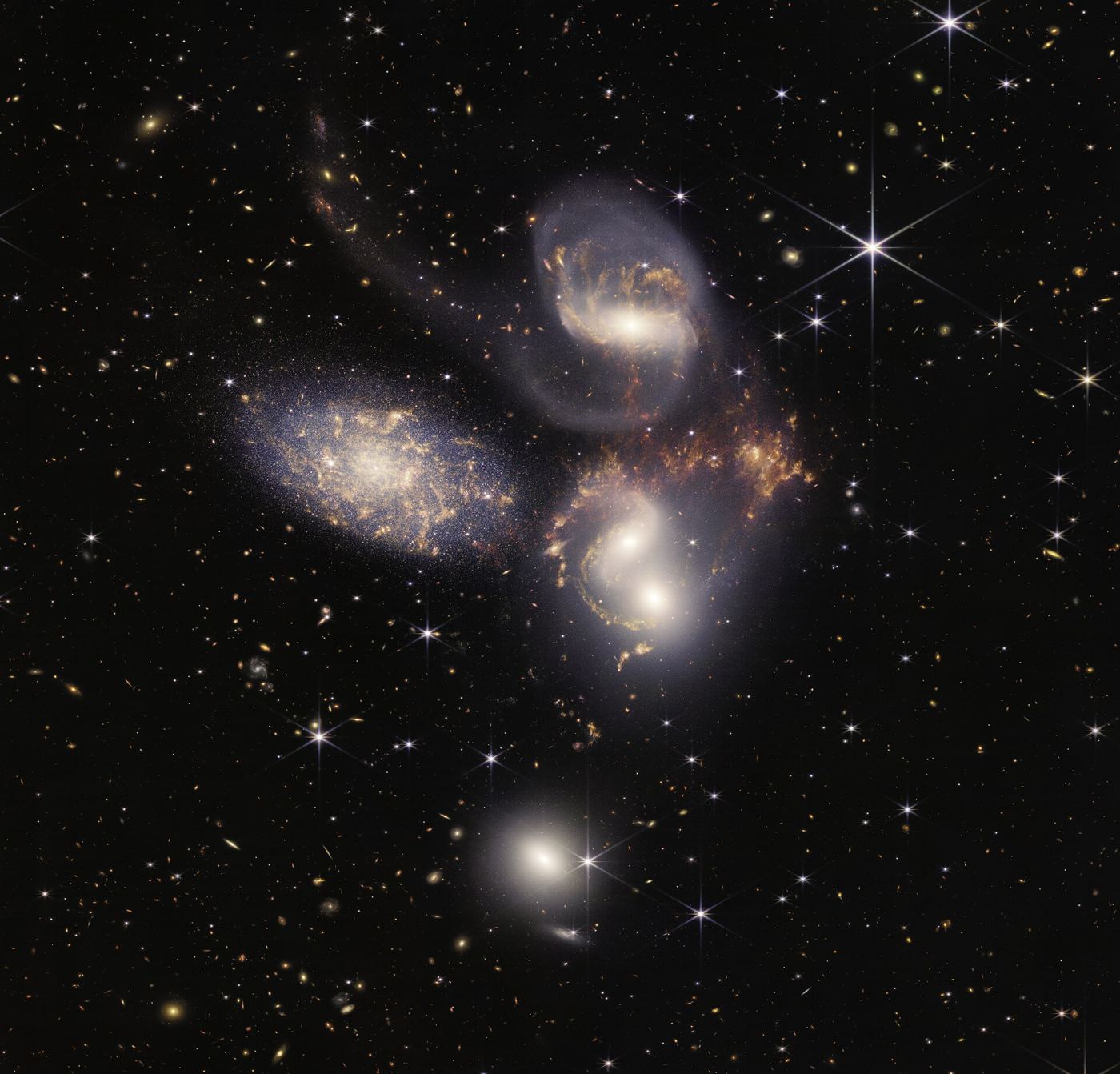

The James Webb Space Telescope has once again pushed the frontier of the observable universe, spotting a galaxy that existed only about 280 million years after the Big Bang. The galaxy, named MoM-z14, is the most distant spectroscopically confirmed object ever found, with a redshift of 14.44, meaning its light has travelled for roughly 13.5 billion years to reach us. Astronomers led by Rohan Naidu at the Massachusetts Institute of Technology announced the discovery after Webb’s NIRSpec instrument spread the galaxy’s faint light into a spectrum, confirming its distance beyond doubt. Surprisingly, MoM-z14 is bright, dense and already chemically rich, far more developed than models predicted for such an early era. The finding, published in the Open Journal of Astrophysics in early 2026, challenges ideas about how quickly the first galaxies could form stars and build up heavy elements. The discovery was made using Webb’s deep survey of the COSMOS field, one of the most intensively studied patches of sky, and the galaxy’s light was first spotted as a faint smudge in infrared images before spectroscopy confirmed its extraordinary distance.
What the Evidence Shows
MoM-z14 replaces the previous record holder, JADES-GS-z14-0, which existed about 300 million years after the Big Bang, and it continues a pattern in which Webb keeps finding unexpectedly mature galaxies in the universe’s infancy. Scientists expected the first galaxies to be small and faint, slowly assembling over hundreds of millions of years, yet Webb has repeatedly found bright, structured systems far earlier than theory allowed. Researchers now debate whether star formation was far more efficient in the early universe, whether the first stars were unusually massive, or whether black holes played a bigger role than assumed. Each new record sharpens the questions rather than settling them, and astronomers expect Webb to break its own record again as its deep surveys continue. For now, MoM-z14 stands as the farthest window yet into the cosmic dawn. The result also matters because the earliest galaxies seeded everything that followed, producing the first stars, the first black holes and the heavy elements that would eventually form planets and people. Reporting and analysis from sources such as National Science Foundation track the same developments, and specialists following most distant galaxy MoM-z14 say the direction is now consistent across independent lines of evidence.
The Wider Context
The wider context is a research landscape in which replication and open data now decide reputations. Findings connected to most distant galaxy MoM-z14 are being checked by independent groups with shared datasets, and the teams involved publish their methods in full so rivals can test every step. That discipline is slower than a headline cycle, but it is why results in this area increasingly survive first contact with scrutiny.
What Happens Next
What happens next in the story of most distant galaxy MoM-z14 will be decided by follow-up work already under way: larger samples, longer observation and instruments that have not yet come online. The researchers involved are unusually united on one point, that the current results justify the next investment of time and money. Readers will not have to wait long for the first tests of that claim. You can follow related developments in our coverage of science.
There is a practical lesson in all of this for readers deciding what to do today. Start with the verified facts, be wary of anyone promising certainty, and prefer reversible steps while the evidence is still developing. Circumstances differ by country, income and personal situation, so general guidance should always be weighed against your own context before you act on it in any significant or lasting way.
