




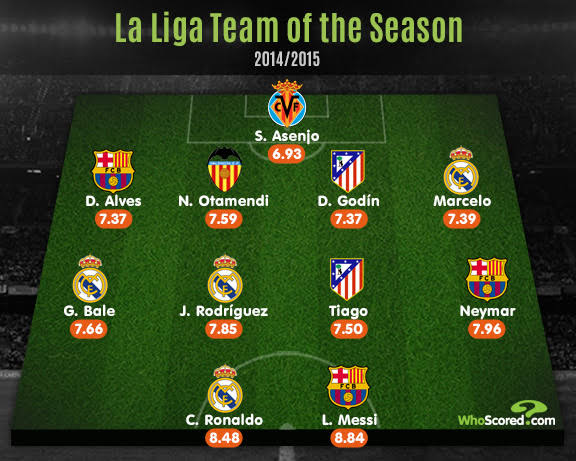
The 2014/2015 La Liga season is frequently remembered for its staggering attacking output, characterized by the historic goal-scoring exploits of Lionel Messi and Cristiano Ronaldo. However, focusing solely on the forwards obscures the tactical and statistical evolution occurring at the opposite end of the pitch. Goalkeepers during this campaign served as more than just a last line of defense; their individual form fundamentally altered the baseline probability of shots converting into goals. By analyzing shot-stopping efficiency through advanced metrics, we can understand how elite keepers consistently defied expected goals ($xG$) models, turning high-probability scoring chances into routine saves and shifting the tactical landscape of Spanish football.
The Baseline of Shot Probability in Spanish Football
Every shot taken in professional football carries an inherent mathematical probability of resulting in a goal, dictated by distance, angle, defensive pressure, and the body part used to strike the ball. In a standardized environment, these metrics provide a stable predictive baseline for team performance and offensive efficiency. Yet, this model assumes an average goalkeeper performance, treating the man between the posts as a static variable rather than a dynamic impediment.
When a goalkeeper experiences a sustained run of peak form, this baseline probability collapses. In the 2014/2015 La Liga season, several shot-stoppers demonstrated the ability to systematically lower the conversion rate of high-value opportunities. This variance forced analysts to reassess the value of shot quality, proving that an elite keeper does not merely react to shot probability, but actively suppresses it through superior positioning, anticipation, and physical execution.
Claudio Bravo and the Tactical System of Barcelona
Claudio Bravo’s debut season at Barcelona stands as a masterclass in how a goalkeeper’s style can complement a high-pressing, possession-oriented tactical system. Securing the Zamora Trophy with a mere 19 goals conceded in 37 appearances, Bravo benefited from a dominant defensive line, but his individual metric contributions were undeniable when called upon.
The Mechanics of Visual Narrowing
Bravo excelled at the mechanics of visual narrowing, a technique where a keeper advances off his line precisely as the attacker prepares to strike, minimizing the visible target area. By maintaining a low center of gravity and utilizing rapid lateral footwork, he forced forwards into rushing their shots, which frequently resulted in off-target attempts or predictable placements.
Conditional Scenarios of Sweeper-Keeping
Under Luis Enrique, Barcelona operated with an aggressive defensive line that left substantial space behind the center-backs. Bravo’s role required constant calculated risk-taking; when an opponent launched a counter-attack, he had to weigh the probability of winning a race to a loose ball against the risk of being lobbed from distance. His flawless execution of this role drastically reduced the number of clear-cut, one-on-one opportunities opponents could generate.
Jan Oblak and the Low-Block Resiliency of Atlético Madrid
While Barcelona relied on controlling space through possession, Diego Simeone’s Atlético Madrid perfected the art of defensive compression, providing a completely different environment for young Jan Oblak. Taking over the starting role permanently in the latter half of the season, Oblak showcased an extraordinary ability to handle high-velocity shots within a crowded penalty area.
Atlético’s low block naturally funneled opposition attacks into wide areas, resulting in a high volume of crosses and contested shots from acute angles. Oblak’s aerial dominance and elite handling meant that second-chance opportunities—which typically carry an exceptionally high goal probability—were virtually non-existent for opponents. His presence transformed high-danger scrambles into controlled reloads for his defense.
Diego Alves and the Psychological Suppression of Penalties
The contribution of Valencia’s Diego Alves during the 2014/2015 campaign highlights how specific situational mastery can skew seasonal statistics. Alves broke the record for the most penalty saves in a single La Liga season during this period, establishing himself as a psychological anomaly that defied standard probability metrics.
From a data perspective, a penalty kick carries a static conversion probability of approximately 76%. When facing Alves, however, this probability plummeted significantly below the historical average. His analytical approach to penalty situations combined intensive study of kicker habits with delayed physical commitment, forcing takers to alter their preferred placement at the final millisecond, often resulting in saved attempts or missed targets altogether.
Quantifying the Variance: Goals Prevented Metrics
To truly appreciate the impact of these goalkeepers, one must move beyond basic clean sheet statistics and look toward Post-Shot Expected Goals ($PSxG$). This metric measures the quality of the shot after it has been struck, evaluating the trajectory and speed of the ball to determine how likely it is to beat an average keeper.
When analyzing the data from the 2014/2015 campaign, the top-tier La Liga keepers consistently registered a positive differential between their $PSxG$ and their actual goals conceded. A positive deviation indicates that a goalkeeper is actively preventing goals that historical data suggests should have been scored, serving as quantifiable proof of a player operating in peak form.
The evaluation of seasonal data requires a structured look at how individual performances deviated from expected baselines across different competitive environments. The table below outlines the specific metrics of the top performing keepers during the 2014/2015 La Liga campaign, highlighting the tangible impact of elite form on defensive outcomes.
| Goalkeeper | Club | Clean Sheets | Goals Conceded (Per 90) | Save Percentage | Penalty Save Success |
| Claudio Bravo | Barcelona | 23 | 0.51 | 79.2% | 0.0% |
| Jan Oblak | Atlético Madrid | 11 | 0.64 | 80.4% | 50.0% |
| Diego Alves | Valencia | 13 | 0.81 | 74.6% | 62.5% |
| Sergio Asenjo | Villarreal | 12 | 0.91 | 75.8% | 33.3% |
The data presented demonstrates that defensive success was achieved through diverse methodology. Bravo’s high clean sheet volume reflects a system that suppressed the total volume of shots allowed, whereas Oblak’s superior save percentage indicates a higher efficiency per shot faced within Atlético’s compressed defensive structure. Alves’s remarkable penalty save success further emphasizes how localized variance can heavily influence a team’s overall defensive resilience during critical match moments.
The Failure Cases of High-Risk Goalkeeping Styles
While elite form can elevate a team’s defensive stability, aggressive or unorthodox goalkeeping styles carry inherent risks that can lead to catastrophic failures when timing or positioning fluctuates by mere fractions of a second. The 2014/2015 season provided several examples of keepers whose high-risk approaches occasionally backfired against elite attacking sides.
When a goalkeeper consistently operates far outside their six-yard box to sweep up long passes, any miscalculation in the speed of the ball or the attacker results in an open net scenario. Furthermore, keepers who favor parrying shots back into the penalty box rather than catching them rely heavily on their defenders winning the second ball; if the defensive line fails to react instantly, the probability of conceding on the rebound increases exponentially, erasing the value of the initial save.
Predictive Modeling and the Limitations of In-Play Adjustments
Understanding the mathematical relationship between a goalkeeper’s current form and real-time shot outcomes is vital for anyone analyzing football dynamics from a data-driven perspective. When live match environments shift, predictive models must quickly recalibrate to account for individual hot streaks that defy seasonal averages. Enthusiasts tracking these shifts often look toward specialized digital platforms to gauge live probabilities, finding that historical trends must be weighed carefully against real-time athletic variance. A knowledgeable analyst observing a high-pressing side facing an elite shot-stopper will recognize that standard scoring metrics overestimate the true probability of success. If a match features a keeper capable of neutralizing high-value chances, accessing a versatile sports betting service like ufa168 เข้าสู่ระบบ allows observers to leverage their insights into in-play realities, shifting their focus away from public consensus toward underlying statistical anomalies.
Evaluating the broader market trends of that season reveals a clear divergence between perceived defensive strength and actual statistical resilience under pressure. The public often overvalued teams with high possession metrics while ignoring the vulnerability of their keepers to sudden, high-velocity counter-attacks that bypassed structural defenses completely.
The Evolution of the Goalkeeper’s Role in Modern Scouting
The performances observed during the 2014/2015 La Liga season accelerated a shift in how professional clubs scouted and valued goalkeepers, transitioning from a reliance on traditional box-presence metrics to comprehensive asset distribution profiling. Teams realized that a keeper who could maintain high shot-stopping efficiency while actively participating in the buildup phase was worth a premium in the transfer market.
This evolution shifted the analytical focus away from raw save counts toward contextual shot suppression. Scouts began isolating specific variables, such as a goalkeeper’s footwork speed when moving from a high stance to a low dive, and how their presence altered the shot selection of oncoming forwards, laying the groundwork for the highly specialized metrics used in the modern era.
Strategic Variations and Divergent Data Environments
Examining the distinct environments across Spanish football highlights that a goalkeeper’s numbers are inextricably linked to the collective tactical philosophy implemented by their manager. A team that forces long-range attempts presents their keeper with a completely different data profile than a team that allows frequent box entries.
Advanced researchers must isolate these structural variables when comparing players across different clubs to avoid drawing flawed conclusions based solely on traditional box scores. For individuals accustomed to analyzing risk and probability patterns across modern digital platforms, identifying these subtle statistical deviations is a familiar challenge. Those who study mathematical advantages in a dynamic casino online environment understand that a minor shift in structural probability can dramatically alter long-term outcomes, a principle that applies perfectly to football analytics where a keeper’s positional adjustments redefine the expected value of every shot faced.
Ultimately, the 2014/2015 La Liga season proved that goalkeeper form is not a static element of a team’s defensive profile. It is a highly volatile, highly impactful variable that can completely decouple a team’s actual defensive record from their expected statistical baselines over the course of a thirty-eight-match domestic campaign.
Summary
The 2014/2015 La Liga season provided clear empirical evidence that elite goalkeeper form serves as a primary disruptive variable against standardized shot probability models. Through distinct tactical executions—ranging from Claudio Bravo’s proactive space management to Jan Oblak’s structural optimization and Diego Alves’s psychological dominance—these shot-stoppers demonstrated that a goal is never a guaranteed outcome of a high-value opportunity. By consistently generating positive differentials against post-shot expected goals, these players proved that individual form can actively manipulate scoring efficiency, reminding analysts that football remains an intricate balance between mathematical probability and human performance.
