



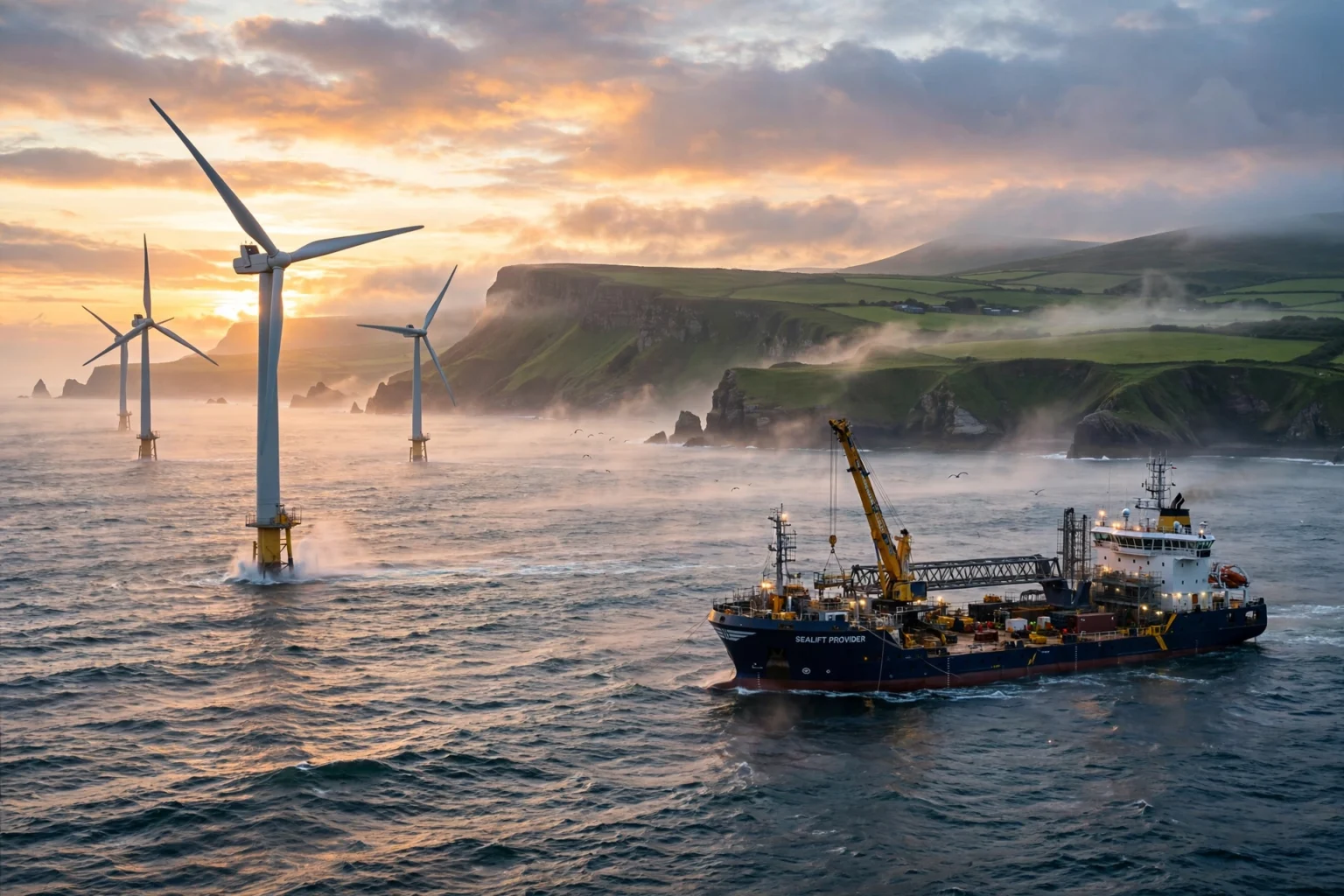

Ireland has talked about harvesting the Atlantic wind for a generation. The resource was never in doubt — few countries in Europe sit beside stronger or steadier offshore winds — but for years the plans stayed on paper, tangled in planning delays, grid constraints and auction designs that failed to attract developers. In 2026, the picture is finally changing. Consented projects are moving toward construction, ports are being rebuilt to service giant turbines, and the first generation of Irish offshore wind farms is becoming a matter of engineering rather than aspiration.
The scale of the ambition
Government targets call for at least 5 gigawatts of offshore wind by 2030, rising far higher in the following decade, as part of a plan for 80 per cent of Ireland’s electricity to come from renewable sources by the end of this decade. The first phase of projects — including developments off the coasts of Wicklow, Dublin, Louth, Galway and Wexford — represents several billion euro of investment. The Sustainable Energy Authority of Ireland, whose work is detailed at SEAI, estimates that meeting the targets would transform Ireland from a heavy importer of fossil fuels into a potential exporter of clean electricity to its neighbours.
From auctions to steel in the water
The turning point was the state’s first offshore renewable energy auction, which awarded contracts to four major projects and gave developers the revenue certainty needed to raise finance. Since then, the work has shifted to the unglamorous essentials: maritime consents under the new planning regime, seabed surveys, cable routes and onshore substations. Ports have become critical infrastructure in their own right. Belfast Harbour has already established itself as a construction hub for the Irish Sea, while Irish ports including Rosslare and Dublin are investing to handle turbine components the size of aircraft wings. Grid operator EirGrid faces the parallel challenge of strengthening the onshore network fast enough to absorb the new power when the wind blows hardest.
Jobs, bills and the local stake
For coastal communities, the projects promise thousands of construction jobs and hundreds of permanent operations roles, plus community benefit funds written into the auction rules. The longer-term prize is energy security: every megawatt generated off the Irish coast is a megawatt not imported as gas at volatile international prices. It is the same infrastructure logic driving the rural broadband rollout we covered in our report on Ireland’s rural broadband milestone — national networks, built slowly and expensively, that quietly change what is possible for the places they reach.
The hurdles that remain
None of this is guaranteed. Planning timelines in Ireland remain long and legally contested; supply chains for turbines, vessels and cables are stretched worldwide; and costs across the offshore industry rose sharply in recent years, forcing some projects in other countries back to the drawing board. Consenting for the second phase, which moves into deeper Atlantic waters and floating turbine technology, will test the system further. Environmental groups, while broadly supportive of offshore wind, continue to press for rigorous protection of seabirds and marine habitats in site selection.
What success would look like
If the current phase delivers on schedule, the first Irish offshore turbines should be exporting power before the decade is out, with the fleet expanding through the early 2030s. The effect would compound: cheaper and cleaner electricity for homes and the data-hungry industries Ireland courts, a new maritime engineering sector, and a genuine claim to energy independence for the first time in the state’s history. After decades of white papers, Ireland’s offshore wind story is finally being written in steel. The next few years of construction will decide whether the long-promised Atlantic harvest lives up to its billing.
